TMJ Disorder Treatment in Wilmington: Why Jaw Pain Is a Neurological Issue
Temporomandibular joint (TMJ) disorder is a condition affecting the jaw joint and its associated muscles that produces pain, clicking, limited movement, and — frequently — symptoms that patients and clinicians alike don't connect to the jaw at all, including headaches, ear pain, tinnitus, neck pain, and facial numbness. At Myrtle Grove Chiropractic in Wilmington, NC, Dr. Margie approaches TMJ disorder as a neurological condition with both local joint and upstream cervical spine components, which is why dental appliances alone often fail to resolve it.
The TMJ affects an estimated 10 million Americans, according to the National Institute of Dental and Craniofacial Research. Women between 20-40 are diagnosed at a 4:1 ratio compared to men, though the reasons for this disparity remain under investigation.
The Anatomy That Makes TMJ a Neurological Problem
The temporomandibular joint sits directly anterior to the ear canal and is innervated by the trigeminal nerve — the fifth cranial nerve and the largest sensory nerve in the head. The trigeminal nerve is also responsible for sensation in the face, scalp, teeth, sinuses, and corneas.
The trigeminal nucleus, where trigeminal pain signals are processed, extends from the brainstem down into the upper cervical spinal cord, overlapping with the processing areas for C1, C2, and C3 nerve roots. This anatomical overlap — called the trigeminocervical nucleus — is why jaw problems produce neck pain, and why neck problems produce jaw and facial symptoms. The two systems share central processing pathways.
This is the neurological reality that purely dental approaches to TMJ miss. An occlusal splint may reduce clenching forces on the joint, but if the cervical spine is subluxated and generating abnormal input into the trigeminocervical nucleus, the central sensitization component of the disorder continues.
The Cervical Spine Connection
Research published in the Journal of Oral Rehabilitation found that patients with TMJ disorder have significantly higher prevalence of cervical dysfunction, particularly at C0-C1 and C1-C2, compared to asymptomatic controls. A 2021 study in Musculoskeletal Science and Practice found that upper cervical manipulation reduced TMJ pain scores and improved mouth opening range of motion in patients with chronic TMD.
The mechanism is twofold:
Postural contribution: Forward head posture, which is extremely common in Wilmington's sedentary population, changes the resting position of the mandible. As the head moves forward, the hyoid drops, the floor of the mouth tightens, and the condyles are displaced posteriorly in the glenoid fossa — directly compressing the retrodiscal tissue of the TMJ.
Neurological contribution: Upper cervical subluxation sensitizes the trigeminocervical nucleus, lowering the threshold for TMJ pain and making the joint reactive to stimuli that wouldn't cause pain in a normally sensitized nervous system.
How Myrtle Grove Chiropractic Approaches TMJ Disorder
Dr. Margie's evaluation for TMJ patients includes:
Cervical range of motion and joint mobility assessment
Palpation of the masticatory muscles (masseter, temporalis, pterygoids) for trigger points and hypertonicity
Jaw opening deviation and range of motion measurement
INSiGHT neurological scanning for upper cervical and brainstem-level nerve interference
Postural assessment for forward head position and shoulder girdle balance
Treatment addresses the cervical spine first. Upper cervical adjustments at C0-C1 and C1-C2 normalize afferent input to the trigeminocervical nucleus, reduce sensitization, and restore normal mandibular resting position through postural correction.
Concurrent soft tissue work on the masticatory muscles directly reduces jaw muscle hypertonicity. In appropriate cases, acupuncture targeting the masseter, temporalis, and ST7 point provides additional neuromuscular relaxation.
Symptoms That Suggest a Cervical TMJ Component
Patients with TMJ disorder who are also experiencing the following symptoms are more likely to have a significant cervical contribution:
Headaches that start at the base of the skull and radiate forward
Neck pain or stiffness with jaw pain
Tinnitus (ringing in the ears) or ear fullness
Dizziness or balance changes
Shoulder tension on the same side as jaw symptoms
Symptoms that worsen after prolonged sitting or screen use
These are not coincidental symptoms. They are neurological output from a shared sensory processing center under chronic stress from both the jaw joint and the upper cervical spine.
When to See a Chiropractor for TMJ in Wilmington
If you have had TMJ symptoms that have not fully responded to dental appliances, anti-inflammatories, or physical therapy targeting the jaw in isolation, a neurological chiropractic evaluation focused on the upper cervical spine may identify the missing piece of your treatment picture.
Myrtle Grove Chiropractic accepts new patients with TMJ disorder throughout Wilmington, Leland, and surrounding New Hanover County communities.
Frequently Asked Questions
Can a chiropractor treat TMJ disorder? Yes. Chiropractic care, particularly upper cervical adjustments, addresses the cervical spine component of TMJ disorder that dental treatments alone cannot reach. Research supports that upper cervical manipulation reduces TMJ pain and improves jaw opening range of motion.
Why does my neck hurt when I have jaw problems? The trigeminal nerve (which innervates the jaw) and the upper cervical nerve roots (C1-C3) share a central processing area called the trigeminocervical nucleus. This anatomical overlap means jaw and neck problems frequently produce overlapping symptoms.
What causes TMJ disorder in Wilmington patients? Common contributors include forward head posture from prolonged device use, stress-related clenching and bruxism, upper cervical joint dysfunction, and post-traumatic changes from car accidents or sports injuries.

Frequently Asked Questions
Myrtle Grove Chiropractic & Acupuncture Center | Wilmington, NC
Got a question? You're not alone. Here are the most common questions we hear from patients in Wilmington and surrounding areas. Can't find your answer? Contact us at 5552 Carolina Beach Rd, Ste F, Wilmington, NC 28412.
Will you pressure me into long-term plans?
No. A good chiropractor recommends care based on your progress and goals, not sales quotas. You’ll never be pushed into prepaid packages.
Do you guarantee results?
No ethical provider guarantees outcomes. Instead, we give honest expectations and focus on steady, realistic improvement.
Will you explain what’s going on with my body?
Yes. You’ll receive clear explanations about your condition, treatment options, and what results you can expect.
Is my care personalized?
Yes. Every treatment plan is tailored to your health history, lifestyle, and specific concerns.
Do you do an exam before treatment?
Yes. We begin with a thorough assessment, health history, and appropriate testing before any adjustments.
Are you properly licensed?
Yes. Our credentials and licensure are current, transparent, and verifiable through the state board.
How do you know when I’m ready to reduce visits?
We base frequency on your progress, stability, and goals—not on contracts. Our goal is independence, not dependence.
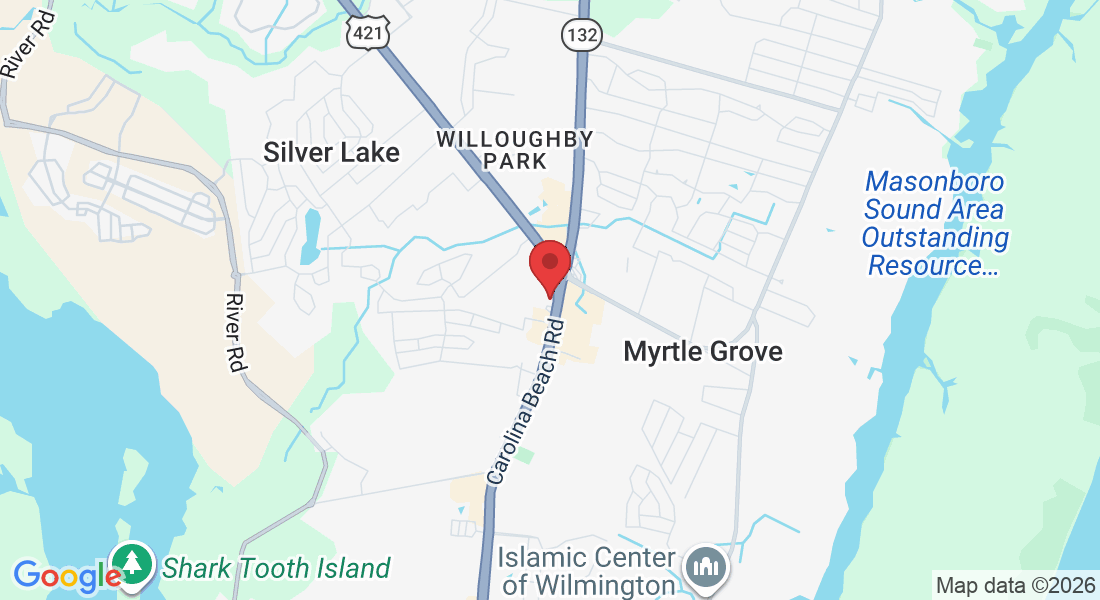
5552 Carolina Beach Rd, Ste F
Wilmington, NC 28412
Phone: (910)-395-5664
Operating Hours
Monday - 8 AM–12 PM
2–6 PM
Tuesday - 8 AM–12 PM
2–6 PM
Wednesday - 8 AM–12 PM
2–6 PM
Thursday - 8 AM–12 PM
2–6 PM
Friday - Closed
Saturday - Closed
Sunday - Closed


