
Posture Correction for Wilmington Athletes: Enhancing Proprioception
Proprioception — the body's internal sense of position, movement, and force — is the foundational performance variable that most Wilmington athletes are not training. Strength, cardiovascular conditioning, and sport-specific skill training are well-addressed in most athletic programs. Proprioceptive accuracy, which depends directly on spinal joint health and postural alignment, is almost never systematically addressed outside of injury rehabilitation. This is a meaningful gap, because proprioceptive deficits are the most reliable predictor of athletic injury risk and the least reliable predictor of performance ceiling.
Why Proprioception Is Tied to Spinal Alignment
Proprioceptive signals — from muscle spindles, Golgi tendon organs, joint mechanoreceptors, and skin receptors — travel to the cerebellum and sensorimotor cortex through the spinal cord. The quality of that input determines how accurately the brain maps body position in space.
Spinal joint dysfunction disrupts this input at the source. Restricted or dysfunctional facet joints fire abnormal mechanoreceptor signals. Subluxated segments generate altered proprioceptive maps that the cerebellum uses for movement organization. The result: the athlete moves with less accuracy than their physical capacity would otherwise allow, takes longer to stabilize after perturbation, and is at elevated injury risk during the split-second balance recovery that sports constantly demand.
A 2015 study in the Journal of Manipulative and Physiological Therapeutics found that athletes receiving chiropractic care showed measurable improvements in proprioceptive accuracy at the ankle and knee compared to control athletes, with corresponding improvements in single-leg balance time and reactive balance tests.
The Wilmington Athletic Context
Wilmington's sports culture places specific postural demands on athletes. Watersports — surfing, paddleboarding, kayaking — require sustained asymmetrical thoracic rotation and dynamic lumbar stability. Running on Wrightsville Beach sand demands greater ankle and subtalar proprioceptive precision than road running. Team sports at UNCW and the area's many adult rec leagues involve the direction changes, overhead demands, and contact forces that load the spine asymmetrically and rapidly.
These athletes arrive at Myrtle Grove Chiropractic with predictable patterns: right thoracic rotation restriction in surfers and golfers, hip flexor dominance and gluteal inhibition in cyclists and runners, shoulder girdle asymmetry in overhead athletes. These are not just injury patterns. They are proprioceptive maps that are directing the athlete's movement organization in ways that limit performance and create vulnerability.
Five Posture Correction Strategies for Athletes
1. Upper cervical alignment: The vestibular system and upper cervical proprioceptors work together to orient the body in space. Upper cervical subluxation introduces conflicting signals between the two systems, creating subtle but measurable balance and coordination deficits. Upper cervical adjustments restore alignment accuracy in this foundational sensorimotor relationship.
2. Thoracic rotation restoration: Restricted thoracic rotation forces compensatory hypermobility in the lumbar spine and shoulder girdle — both high-injury zones for most athletes. Thoracic adjustments directly restore rotational capacity and redistribute motion loading appropriately.
3. Hip flexor and thoracolumbar fascia release: The hip flexors attach to the lumbar spine (psoas at L1-L5). Chronic hip flexor tightness creates anterior pelvic tilt, increased lumbar compression, and altered gluteal firing — a pattern that reduces hip extension power and creates the foot strike and deceleration mechanics associated with hamstring and ACL injuries.
4. Foot and ankle proprioceptive activation: Plantar fascia and subtalar joint mechanoreceptors feed directly into the postural reflexes that govern whole-body stability. Chiropractic assessment of the foot and ankle complex — often overlooked in spinal-focused practices — identifies restrictions that reduce proprioceptive signal quality from the ground up.
5. INSiGHT baseline for athletes: Athletes who have never had a neurological scan do not know whether their nervous system is operating at its proprioceptive capacity or whether there are latent spinal interference patterns limiting their performance. A baseline INSiGHT scan at Myrtle Grove Chiropractic establishes this baseline and identifies the regions most limiting optimal proprioceptive function.
Working with Wilmington Athletes
Dr. Margie's sports chiropractic work at Myrtle Grove accommodates athletes at all levels — recreational surfers and runners through competitive UNCW and adult league athletes. Sport-specific assessment focuses on the movement demands of the athlete's particular activity, not just a generic postural screen.
Contact Myrtle Grove Chiropractic to schedule an athletic performance assessment.

Frequently Asked Questions
Myrtle Grove Chiropractic & Acupuncture Center | Wilmington, NC
Got a question? You're not alone. Here are the most common questions we hear from patients in Wilmington and surrounding areas. Can't find your answer? Contact us at 5552 Carolina Beach Rd, Ste F, Wilmington, NC 28412.
Will you pressure me into long-term plans?
No. A good chiropractor recommends care based on your progress and goals, not sales quotas. You’ll never be pushed into prepaid packages.
Do you guarantee results?
No ethical provider guarantees outcomes. Instead, we give honest expectations and focus on steady, realistic improvement.
Will you explain what’s going on with my body?
Yes. You’ll receive clear explanations about your condition, treatment options, and what results you can expect.
Is my care personalized?
Yes. Every treatment plan is tailored to your health history, lifestyle, and specific concerns.
Do you do an exam before treatment?
Yes. We begin with a thorough assessment, health history, and appropriate testing before any adjustments.
Are you properly licensed?
Yes. Our credentials and licensure are current, transparent, and verifiable through the state board.
How do you know when I’m ready to reduce visits?
We base frequency on your progress, stability, and goals—not on contracts. Our goal is independence, not dependence.
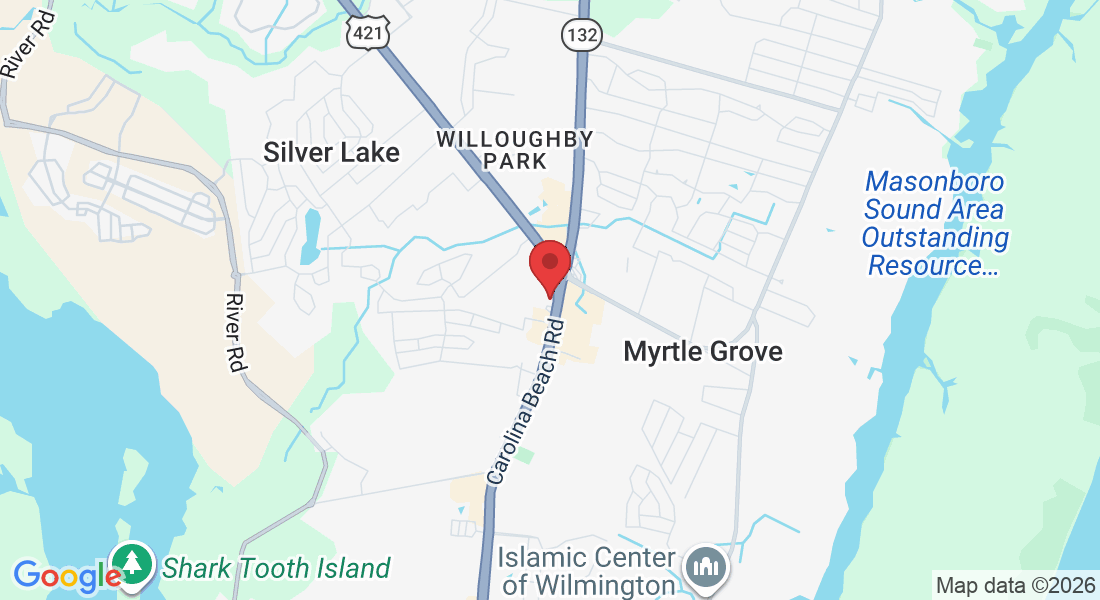
5552 Carolina Beach Rd, Ste F
Wilmington, NC 28412
Phone: (910)-395-5664
Operating Hours
Monday - 8 AM–12 PM
2–6 PM
Tuesday - 8 AM–12 PM
2–6 PM
Wednesday - 8 AM–12 PM
2–6 PM
Thursday - 8 AM–12 PM
2–6 PM
Friday - Closed
Saturday - Closed
Sunday - Closed


