
Nervous System Dysregulation: Symptoms and Long-Term Health Impacts
Nervous system dysregulation is a state in which the autonomic nervous system's two branches — the sympathetic (fight-or-flight) and parasympathetic (rest-and-digest) divisions — lose their ability to shift flexibly between activation and recovery. The result is a body that stays in a chronic low-level state of threat response even when no real threat exists. This state is measurable, consequential, and — when identified early — addressable through neurological chiropractic care, targeted lifestyle intervention, and adjunctive therapies.
What Nervous System Dysregulation Actually Feels Like
Patients with autonomic dysregulation rarely describe it in those terms. They describe:
Waking up exhausted despite 7-8 hours of sleep
Racing thoughts at night with an inability to wind down
Digestive irregularity (constipation, IBS, bloating) with no identified GI pathology
Frequent illness or slow recovery from minor infections
Heightened startle response or feeling "on edge" without clear cause
Blood pressure that spikes unpredictably
Heart rate that doesn't come down quickly after mild exertion
Jaw clenching, tension headaches, neck tightness that returns despite treatment
These symptoms span multiple body systems because the autonomic nervous system regulates all of them. Conventional medicine tends to evaluate and treat each symptom in isolation — the gastroenterologist for the gut symptoms, the cardiologist for the blood pressure variability, the neurologist for the headaches. None of these specialists is wrong. But if the underlying driver is shared autonomic dysregulation, addressing each downstream symptom individually produces limited results.
Physiological Mechanisms of Dysregulation
HPA Axis Overactivation: Chronic stress — whether from psychological sources, physical pain, or spinal nerve irritation — keeps the hypothalamic-pituitary-adrenal axis activated. Cortisol stays elevated. The hippocampus, which normally puts the brakes on the HPA response, becomes increasingly impaired by chronic cortisol exposure — creating a self-perpetuating cycle.
Polyvagal Theory Framework: Dr. Stephen Porges' polyvagal theory identifies a ventral vagal state (safe, socially engaged, regulatory) and a dorsal vagal state (shutdown, freeze, disconnection) as distinct from simple sympathetic-parasympathetic balance. Chronic dysregulation can manifest as either chronic sympathetic overactivation or chronic dorsal vagal shutdown — both are forms of dysregulation, though they feel completely different to the patient.
Spinal Contribution: Vertebral subluxations at specific levels create ongoing nociceptive and proprioceptive input that the brain processes as a continuous low-level threat signal. This is why patients with chronic spinal dysfunction frequently show elevated sympathetic tone on HRV testing even in the absence of active pain — the nervous system is responding to aberrant input that it cannot distinguish from threat input.
Long-Term Health Consequences
Unaddressed autonomic dysregulation is not a quality-of-life issue alone. The epidemiological consequences are well-documented:
Low HRV (the objective marker of dysregulation) increases all-cause cardiovascular mortality risk by 45% in the largest meta-analyses
Chronic cortisol elevation is a primary driver of visceral adiposity, insulin resistance, and metabolic syndrome
Immune suppression from chronic sympathetic dominance increases susceptibility to both infections and autoimmune conditions
Neurological: chronic HPA activation accelerates hippocampal volume loss associated with cognitive decline
The Adverse Childhood Experiences (ACE) research by Felitti et al., originally published in the American Journal of Preventive Medicine in 1998 and replicated in dozens of subsequent studies, found that cumulative early life stress — which creates lasting autonomic dysregulation — is the single strongest predictor of adult chronic disease burden across nearly every disease category.
Measuring and Addressing Dysregulation at Myrtle Grove
INSiGHT scanning at Myrtle Grove Chiropractic makes autonomic dysregulation measurable rather than subjective. HRV assessment provides a quantitative autonomic balance score. Thermal scanning identifies spinal levels generating the most significant autonomic nerve interference. sEMG maps the muscle tension patterns that correspond to those levels.
Treatment addresses the spinal source of afferent dysregulation input through neurological chiropractic care, with BrainTap neurostimulation and HBOT as adjuncts for patients whose dysregulation has a significant learned stress component or inflammatory driver.
Dysregulation is not a permanent state. With proper identification of its drivers and a systematic approach to removing them, the nervous system has substantial capacity to recalibrate — particularly when the structural component is addressed early.

Frequently Asked Questions
Myrtle Grove Chiropractic & Acupuncture Center | Wilmington, NC
Got a question? You're not alone. Here are the most common questions we hear from patients in Wilmington and surrounding areas. Can't find your answer? Contact us at 5552 Carolina Beach Rd, Ste F, Wilmington, NC 28412.
Will you pressure me into long-term plans?
No. A good chiropractor recommends care based on your progress and goals, not sales quotas. You’ll never be pushed into prepaid packages.
Do you guarantee results?
No ethical provider guarantees outcomes. Instead, we give honest expectations and focus on steady, realistic improvement.
Will you explain what’s going on with my body?
Yes. You’ll receive clear explanations about your condition, treatment options, and what results you can expect.
Is my care personalized?
Yes. Every treatment plan is tailored to your health history, lifestyle, and specific concerns.
Do you do an exam before treatment?
Yes. We begin with a thorough assessment, health history, and appropriate testing before any adjustments.
Are you properly licensed?
Yes. Our credentials and licensure are current, transparent, and verifiable through the state board.
How do you know when I’m ready to reduce visits?
We base frequency on your progress, stability, and goals—not on contracts. Our goal is independence, not dependence.
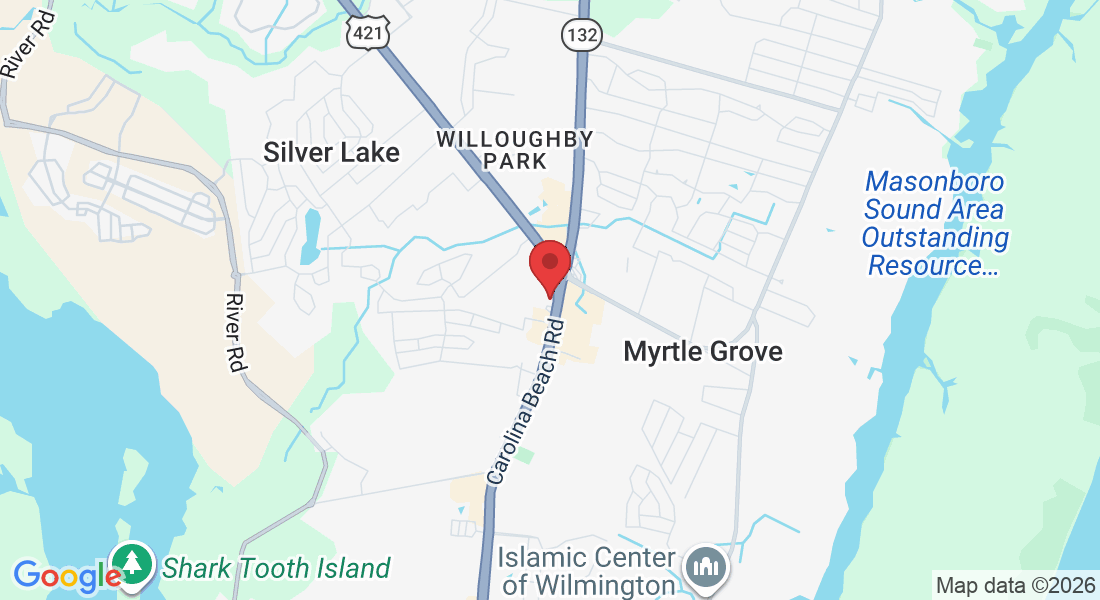
5552 Carolina Beach Rd, Ste F
Wilmington, NC 28412
Phone: (910)-395-5664
Operating Hours
Monday - 8 AM–12 PM
2–6 PM
Tuesday - 8 AM–12 PM
2–6 PM
Wednesday - 8 AM–12 PM
2–6 PM
Thursday - 8 AM–12 PM
2–6 PM
Friday - Closed
Saturday - Closed
Sunday - Closed


