
Migraine Pathophysiology: How Cervicogenic Issues Trigger Chronic Headaches
Cervicogenic headache is a secondary headache disorder in which pain originates from the cervical spine and is referred to the head — mimicking migraine in its quality, location, and associated symptoms. It is estimated to account for 15-20% of all chronic headaches, according to a review in Cephalalgia, yet it is routinely misdiagnosed as migraine and treated with medications that do not address the structural source. Understanding the pathophysiology of cervicogenic-migraine interaction is essential for Wilmington patients who have been managing chronic headaches with preventive medications without achieving adequate control.
The Trigeminocervical Nucleus: Where Migraines and Cervical Pain Converge
The trigeminocervical nucleus (TCN) is the central anatomical explanation for the relationship between cervical spine dysfunction and migraine. The TCN is a continuous sensory nucleus extending from the trigeminal nucleus caudalis in the brainstem down to the C2-C3 levels of the cervical spinal cord.
Both the trigeminal nerve (which carries pain from the face, head, dura mater, and intracranial blood vessels) and the upper cervical nerve roots (C1, C2, C3 — which innervate the posterior scalp, upper neck, and suboccipital region) converge at this nucleus. This anatomical convergence means:
Cervical pathology sensitizes TCN neurons, lowering the threshold for trigeminal pain signal amplification
Migraine-associated sensitization of the TCN lowers the threshold for cervical pain perception
The two systems mutually reinforce each other's chronicity
A 2010 landmark paper in The Journal of Headache and Pain by Bartsch and Goadsby confirmed that cervical afferent input directly modulates trigeminovascular processing — providing the mechanistic link that explains why cervical manipulation can reduce both migraine frequency and migraine-associated neck pain.
Structural Contributors to Cervicogenic Migraine Trigger
Upper cervical subluxation (C0-C2): The most clinically significant structural driver. Subluxation at the atlanto-occipital (C0-C1) and atlantoaxial (C1-C2) joints generates aberrant mechanoreceptor input that reaches the TCN continuously. Over time, this input sensitizes the TCN and lowers the threshold for migraine trigger activation.
Suboccipital muscle hypertonicity: The four suboccipital muscles (rectus capitis posterior major and minor, obliquus capitis superior and inferior) are unique in their high density of muscle spindles — proprioceptive sensors that continuously report cervical position to the brainstem. When these muscles are in sustained tension (chronic desk posture, stress, poor sleep position), they generate a high volume of aberrant proprioceptive input directly into the TCN.
Cervicogenic dural traction: The posterior dura of the spinal cord has fibrous connections to the posterior cervical muscles and ligaments. Myodural bridges at C1 and C2 mean that posterior cervical muscle tension can directly tug on the dura — a pain-sensitive structure — generating intracranial pain referral patterns characteristic of migraine.
What This Means for Migraine Treatment
The clinical implication is clear: if a patient's migraine frequency is being driven or amplified by upper cervical sensitization of the TCN, pharmacological migraine prevention — triptans, beta-blockers, topiramate, CGRP antagonists — addresses the downstream trigeminal cascade but not the upstream cervical input that is triggering it.
This explains the clinical observation that many migraine patients have incomplete responses to first-line preventive medications. The medications suppress the trigeminal activation cascade, but the cervical sensitization input continues to lower the trigger threshold.
The Evidence for Chiropractic in Migraine Management
A 2011 systematic review and meta-analysis in the Journal of Manipulative and Physiological Therapeutics evaluated the evidence for spinal manipulation in migraine and cervicogenic headache. The review found that spinal manipulation was as effective as prophylactic medication for reducing migraine frequency, with superior durability of effect at follow-up compared to medication alone.
A 2017 randomized controlled trial in the European Journal of Neurology compared combined chiropractic-physiotherapy treatment to standard care for chronic migraine. The combined group showed 45% greater reduction in monthly migraine days at 6 months.
Dr. Margie's Approach at Myrtle Grove Chiropractic
Headache patients at Myrtle Grove begin with a detailed history that identifies headache phenotype, cervical trigger patterns (positional changes, neck movements that trigger headaches, morning headaches correlating with sleep position), and INSiGHT scanning focused on the upper cervical region and brainstem-level nerve function.
Care focuses on upper cervical adjustments at C0-C1 and C1-C2, soft tissue work on the suboccipital muscles, and postural correction addressing the forward head position that maintains the mechanical trigger pattern. Most patients with cervicogenic migraine components see meaningful changes in headache frequency within 8-12 visits when the cervical component is properly identified and addressed.
Frequently Asked Questions
What is cervicogenic headache? Cervicogenic headache is a secondary headache where pain originates from the cervical spine and is referred to the head. It accounts for an estimated 15-20% of chronic headaches and is frequently misdiagnosed as primary migraine, leading to pharmacological treatment that does not address the structural source.
Can chiropractic care reduce migraine frequency? Yes. A 2011 meta-analysis found spinal manipulation was as effective as prophylactic migraine medication for reducing headache frequency. Treatment is most effective when the upper cervical spine is identified as a contributing sensitization factor.
How do I know if my migraines have a cervical component? Signs of cervical migraine contribution include headaches that begin at the base of the skull, headaches associated with neck pain or stiffness, headaches that worsen with neck movements or sustained postures, and headaches that are consistently worse in the morning after certain sleep positions.

Frequently Asked Questions
Myrtle Grove Chiropractic & Acupuncture Center | Wilmington, NC
Got a question? You're not alone. Here are the most common questions we hear from patients in Wilmington and surrounding areas. Can't find your answer? Contact us at 5552 Carolina Beach Rd, Ste F, Wilmington, NC 28412.
Will you pressure me into long-term plans?
No. A good chiropractor recommends care based on your progress and goals, not sales quotas. You’ll never be pushed into prepaid packages.
Do you guarantee results?
No ethical provider guarantees outcomes. Instead, we give honest expectations and focus on steady, realistic improvement.
Will you explain what’s going on with my body?
Yes. You’ll receive clear explanations about your condition, treatment options, and what results you can expect.
Is my care personalized?
Yes. Every treatment plan is tailored to your health history, lifestyle, and specific concerns.
Do you do an exam before treatment?
Yes. We begin with a thorough assessment, health history, and appropriate testing before any adjustments.
Are you properly licensed?
Yes. Our credentials and licensure are current, transparent, and verifiable through the state board.
How do you know when I’m ready to reduce visits?
We base frequency on your progress, stability, and goals—not on contracts. Our goal is independence, not dependence.
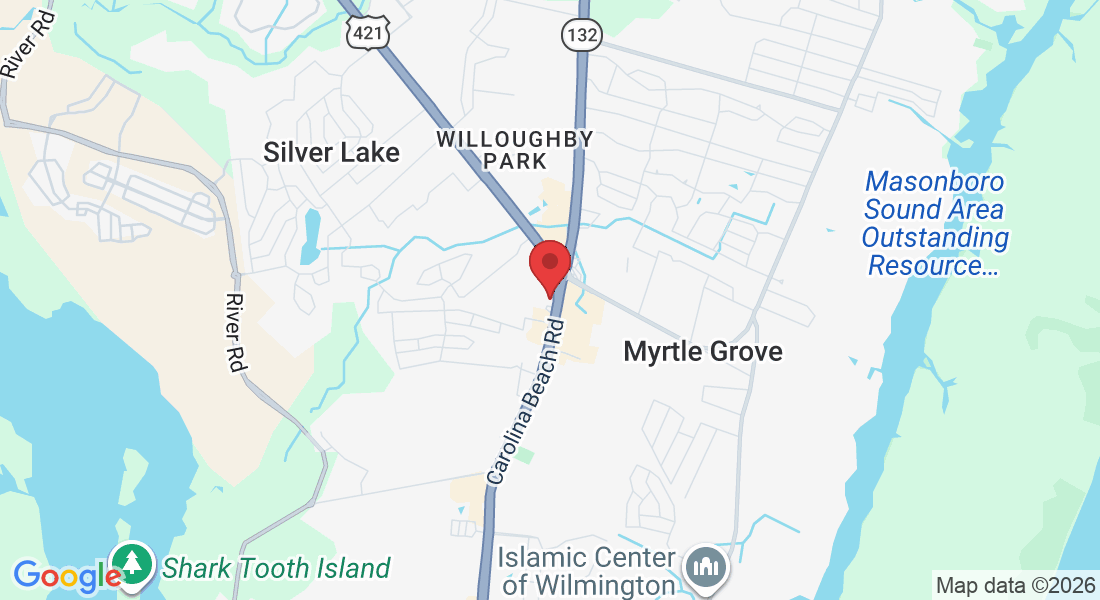
5552 Carolina Beach Rd, Ste F
Wilmington, NC 28412
Phone: (910)-395-5664
Operating Hours
Monday - 8 AM–12 PM
2–6 PM
Tuesday - 8 AM–12 PM
2–6 PM
Wednesday - 8 AM–12 PM
2–6 PM
Thursday - 8 AM–12 PM
2–6 PM
Friday - Closed
Saturday - Closed
Sunday - Closed


