
Back Pain Relief in Wilmington, NC: 7 Evidence-Based Treatment Options
Introduction
Back pain is the silent epidemic of modern life. Eight out of ten Americans experience back pain at some point—and many of them suffer for years without relief.
You might have tried everything: ice, heat, stretching, over-the-counter pain medication. You've probably spent money on treatments that promised relief but delivered nothing. And you're tired of hearing "just rest and it will get better" when you know it's not working.
The good news: Chronic back pain doesn't have to be permanent. The better news: You have options beyond medication and injections.
In this guide, we'll walk you through seven evidence-based treatment options for back pain—from chiropractic adjustments to acupuncture—and explain exactly which one might be right for your specific situation. By the end, you'll understand why Myrtle Grove Chiropractic in Wilmington, NC has helped hundreds of people get their lives back.
Understanding Back Pain: Why It Starts & Why It Persists
Back pain doesn't appear randomly. It has a cause—even if you can't remember exactly when it started.
Common Causes of Back Pain
Muscle strain — You lifted something wrong, sat in a bad position for too long, or made a sudden movement. Your muscle fibers stretched beyond their limit, creating micro-tears and inflammation.
Disc problems — Your vertebrae are cushioned by discs filled with gel. When a disc bulges or herniates, it can press on nerves, creating sharp pain that radiates down your leg.
Spinal misalignment (subluxation) — Your vertebrae shift out of proper alignment. Even a small misalignment changes how your spine distributes force, leading to muscle tension and pain.
Facet joint dysfunction — The small joints between your vertebrae (facet joints) can become inflamed or arthritic, causing localized back pain.
Poor posture — Sitting with rounded shoulders, hunching over your desk, or standing with your pelvis tilted forward puts constant stress on your back. Over weeks and months, this stress accumulates.
Lifestyle factors — Lack of exercise, stress, poor sleep, and excess weight all contribute to back pain by weakening supporting muscles and increasing inflammation.
Why Back Pain Becomes Chronic
Most back pain starts acutely—a specific injury or event. But acute pain becomes chronic when:
You never address the root cause (you just treat the symptoms)
Your body develops compensatory movement patterns (you favor one side, which creates new pain)
Inflammation becomes persistent (your body stays in "protection mode")
You avoid movement (muscles weaken, making pain worse)
This is why pain medication alone doesn't work. Pills mask the symptom but don't fix what's wrong.
Treatment Option #1: Chiropractic Adjustments
Chiropractic care is the most common treatment for back pain—and for good reason. It works.
How Chiropractic Adjustments Help Back Pain
When your spine is misaligned, your nervous system is irritated. Nerves get pinched. Muscles stay contracted. Pain persists.
A chiropractic adjustment realigns your vertebrae, which:
Reduces nerve irritation immediately
Allows muscles to relax
Restores normal movement patterns
Improves blood flow to the injured area
The research: Studies show chiropractic adjustments are as effective as physical therapy and medication for acute and chronic back pain—without the side effects of drugs.
What to Expect
Your first appointment includes a thorough evaluation (posture, range of motion, spinal alignment). Your chiropractor identifies exactly which vertebrae are misaligned and why.
Then comes the adjustment itself—a quick, controlled movement that realigns your spine. Many patients feel immediate relief. Others notice improvement over 2-3 visits.
Timeline: Most back pain improves significantly within 4-6 weeks of regular adjustments.
Treatment Option #2: Acupuncture for Back Pain
Acupuncture is thousands of years old. Modern science is finally catching up to what practitioners have known for centuries: it works for back pain.
How Acupuncture Reduces Back Pain
Acupuncture stimulates your nervous system to:
Release endorphins (natural pain-relieving chemicals)
Reduce inflammatory signals
Improve blood flow to the injured area
"Turn off" pain signals before they reach your brain
The research: Recent studies show acupuncture is more effective than medication for chronic back pain—and the relief lasts longer.
What to Expect
Your acupuncturist identifies points related to your back pain (some are on your back, others elsewhere on your body—this surprises people). They insert very thin needles at these points.
You relax for 20-30 minutes while the needles do their work. Most people find it deeply relaxing, not painful.
Timeline: You typically feel relief within 2-3 sessions. Chronic pain often improves significantly within 6-8 sessions.
Treatment Option #3: Soft Tissue Therapy
Your back pain might not be in your bones—it might be in your muscles, tendons, and fascia.
Types of Soft Tissue Therapy
Therapeutic massage — Breaks up muscle knots and scar tissue that limit movement and cause pain.
Trigger point release — Targets specific "trigger points" (tight knots in muscles) that refer pain to other areas. Releasing a trigger point in your lower back might immediately relieve pain in your hip.
Myofascial release — Works with the fascia (connective tissue wrapping your muscles) to restore normal movement. Tight fascia is a common cause of chronic back pain.
Why Soft Tissue Therapy Works
Muscle tension doesn't just cause pain—it causes misalignment. Tight muscles pull your spine out of position. When you release the muscle tension, your spine naturally realigns.
Timeline: Relief often happens immediately during treatment, with lasting improvement over 4-6 sessions.
Treatment Option #4: Physical Therapy & Exercise
Movement is medicine. This is hard to accept when you're in pain, but avoiding movement makes back pain worse.
Specific Exercises for Back Pain
Your physical therapist identifies which muscles are weak and which are tight. Then they prescribe specific exercises:
Core strengthening — Your core muscles (deep abdominal muscles, back muscles, hip muscles) support your spine. Strengthening them takes pressure off injured discs and joints.
Stretching and flexibility — Tight hamstrings, hip flexors, and chest muscles all pull on your back. Stretching these areas relieves tension.
Movement pattern retraining — If you've been favoring one side or moving inefficiently, your therapist teaches you correct movement patterns.
Why This Works
Weak muscles can't support your spine properly. Tight muscles create misalignment. Exercise fixes both problems simultaneously.
Timeline: You might feel better immediately (movement increases endorphins). Significant improvement typically takes 6-8 weeks of consistent exercise.
Treatment Option #5: Postural Correction & Ergonomics
Your posture might be causing your back pain right now.
Common Postural Problems
Anterior pelvic tilt — Your pelvis tilts forward, exaggerating your lower back curve. This puts constant stress on your lower back and discs.
Rounded shoulders — Hunching forward tightens your chest and upper back, pulling your entire spine out of alignment.
Forward head posture — Your head juts forward (common from phone and computer use). This increases load on your neck and upper back by 10x.
Sitting slump — You collapse into your chair, rounding your entire spine. This position is terrible for your discs.
How to Fix It
At your desk:
Sit with your feet flat, hips and knees at 90 degrees
Keep your monitor at eye level
Take breaks every 30 minutes to stand and move
When standing:
Keep your ears over your shoulders
Keep your shoulders back (not hunched)
Engage your core lightly
Keep your hips neutral (not tilted forward)
When sleeping:
Sleep on your side with a pillow supporting your neck (not your head)
Use a pillow between your knees
Avoid sleeping on your stomach
Why This Matters
Postural problems are often THE cause of back pain. Fixing your posture alone can eliminate pain—without any other treatment.
Timeline: You might notice improvement immediately. Significant change takes 2-4 weeks as your body adjusts to correct positioning.
Treatment Option #6: Anti-Inflammatory Nutrition
Chronic back pain is often chronic inflammation. What you eat directly affects inflammation.
Foods That Increase Inflammation
Processed foods and sugar (spike inflammation)
Vegetable oils (omega-6 imbalance)
Alcohol (increases inflammatory markers)
Refined carbohydrates (spike blood sugar, trigger inflammation)
Foods That Reduce Inflammation
Fatty fish (salmon, sardines) — omega-3 fatty acids
Leafy greens — antioxidants and minerals
Berries — anthocyanins reduce inflammation
Turmeric and ginger — natural anti-inflammatory compounds
Nuts and seeds — omega-3s and magnesium
How This Works
Inflammation is your body's protective response, but chronic inflammation becomes destructive. Anti-inflammatory foods reduce inflammatory markers in your blood, which decreases pain.
Timeline: You might feel better within 1-2 weeks of dietary changes. Significant improvement takes 4-6 weeks.
Treatment Option #7: Stress Reduction & Sleep Optimization
Stress and poor sleep are invisible causes of back pain.
The Stress-Pain Connection
Stress triggers muscle tension. Your body literally braces itself in response to emotional stress. Over time, this chronic tension leads to pain.
Additionally, stress hormones (cortisol) increase inflammation and slow healing.
Sleep & Back Pain
Your body heals during sleep. Poor sleep = poor healing = persistent pain.
How to Reduce Stress & Improve Sleep
Stress reduction:
Daily meditation (even 5 minutes helps)
Regular exercise (releases stress hormones)
Breathing exercises (activates your parasympathetic nervous system)
Time in nature
Sleep optimization:
Keep your bedroom cool and dark
Avoid screens 1 hour before bed
Maintain a consistent sleep schedule
Avoid caffeine after 2 PM
Timeline: You might sleep better that very night. Pain improvement from better sleep takes 1-2 weeks.
Which Treatment is Right for You?
Acute back pain (sudden onset, less than 6 weeks):
Start with chiropractic adjustments + ice/rest
Add physical therapy if pain persists
Add acupuncture if inflammation is severe
Chronic back pain (lasting more than 6 weeks):
Start with chiropractic care
Add acupuncture for inflammation
Add soft tissue therapy for muscle tension
Add exercise/physical therapy for long-term strength
Postural back pain (worsens with sitting/standing):
Fix your posture first
Add ergonomic changes
Add exercise for core strength
Stress-related back pain (worse when stressed):
Add stress reduction practices
Improve sleep quality
Add gentle movement (yoga, walking)
Why Choose Myrtle Grove Chiropractic for Back Pain Relief in Wilmington, NC
We don't just treat back pain. We eliminate it.
Here's what sets us apart:
Thorough diagnosis — We find the actual cause of your pain, not just treat symptoms. Some back pain is from your spine. Some is from tight muscles. Some is from poor posture. We know the difference.
Personalized treatment — We combine the treatments that work for YOUR specific situation. Someone with a bulging disc needs different treatment than someone with muscle tension.
Multiple treatment options — Chiropractic adjustments, acupuncture, soft tissue therapy, exercise prescription. We use what works.
Long-term solutions — We don't want you coming back forever. We teach you how to prevent back pain from returning with posture, exercise, and lifestyle changes.
Local expertise — We've treated hundreds of Wilmington residents with back pain. We understand the lifestyles that cause pain in our community (desk jobs, sedentary living, stress).
Your Back Pain Doesn't Have to Be Permanent
Millions of people live with chronic back pain thinking it's just part of getting older. It's not.
Back pain has a cause. And when you address the cause—not just the symptom—relief is possible.
At Myrtle Grove Chiropractic in Wilmington, NC, we've helped hundreds of people go from chronic pain to pain-free living. Your story could be next.
Ready to get your life back? Schedule your back pain evaluation today.
Call (910) 395-5664 or click below to book your appointment.
Ready to Eliminate Your Back Pain?
Don't spend another day living with pain. Myrtle Grove Chiropractic offers evidence-based treatment for back pain in Wilmington, NC and surrounding areas.
Call: (910) 395-5664 | Hours: Monday-Thursday, 8am-5pm
Related Articles
Learn more about back pain relief:

Frequently Asked Questions
Myrtle Grove Chiropractic & Acupuncture Center | Wilmington, NC
Got a question? You're not alone. Here are the most common questions we hear from patients in Wilmington and surrounding areas. Can't find your answer? Contact us at 5552 Carolina Beach Rd, Ste F, Wilmington, NC 28412.
Will you pressure me into long-term plans?
No. A good chiropractor recommends care based on your progress and goals, not sales quotas. You’ll never be pushed into prepaid packages.
Do you guarantee results?
No ethical provider guarantees outcomes. Instead, we give honest expectations and focus on steady, realistic improvement.
Will you explain what’s going on with my body?
Yes. You’ll receive clear explanations about your condition, treatment options, and what results you can expect.
Is my care personalized?
Yes. Every treatment plan is tailored to your health history, lifestyle, and specific concerns.
Do you do an exam before treatment?
Yes. We begin with a thorough assessment, health history, and appropriate testing before any adjustments.
Are you properly licensed?
Yes. Our credentials and licensure are current, transparent, and verifiable through the state board.
How do you know when I’m ready to reduce visits?
We base frequency on your progress, stability, and goals—not on contracts. Our goal is independence, not dependence.
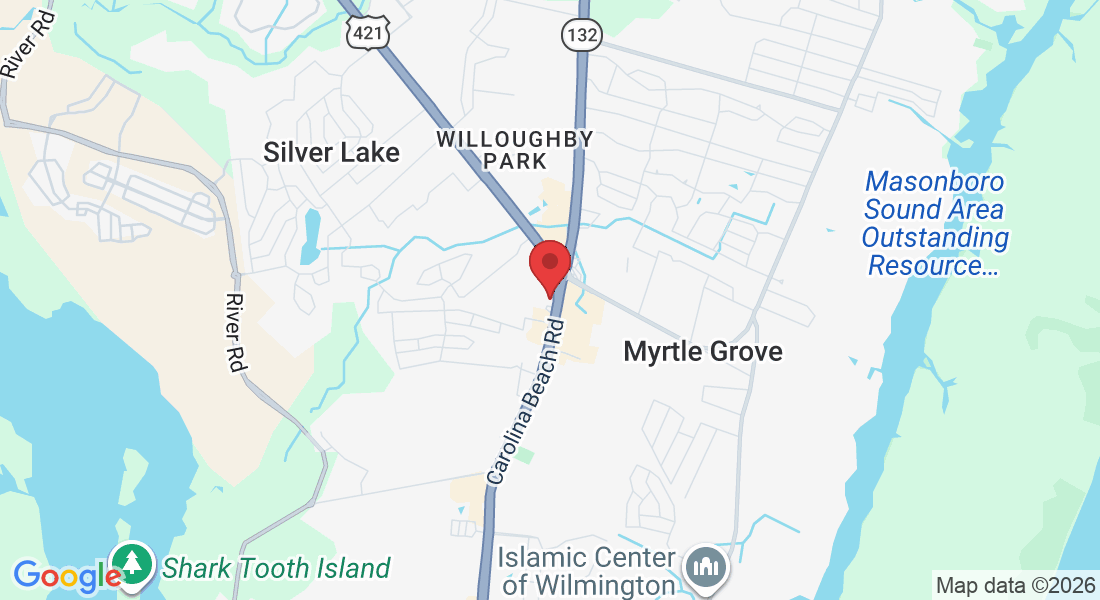
5552 Carolina Beach Rd, Ste F
Wilmington, NC 28412
Phone: (910)-395-5664
Operating Hours
Monday - 8 AM–12 PM
2–6 PM
Tuesday - 8 AM–12 PM
2–6 PM
Wednesday - 8 AM–12 PM
2–6 PM
Thursday - 8 AM–12 PM
2–6 PM
Friday - Closed
Saturday - Closed
Sunday - Closed


